How Much Can You Borrow From Possible Finance?
Possible Finance loans range from $50 to $600 in 2026, with the actual amount you'll qualify for depending on your state, banking activity, and history with the lender. Here's the complete breakdown of what drives loan amounts up or down.
In this guide
The Full Loan Range
Possible Finance offers three distinct products with different amount limits. Most borrowers think only of "the Possible Loan," but understanding the full range matters because the amounts and structures are different:
Within each product, the actual amount you'll be offered depends on your specific application — Possible doesn't set a one-size-fits-all amount. The underwriting algorithm looks at your banking activity and approves the highest amount it believes you can comfortably repay.
State Maximums Explained
Your state's lending laws set a hard ceiling. Even with perfect banking activity, you cannot be approved for more than your state allows:
| Maximum Amount | States |
|---|---|
| $600 | Delaware, Florida, Idaho, Ohio, Texas, Utah, Washington |
| $500 | Alaska, Alabama, Arkansas, Arizona, California, Hawaii, Indiana, Iowa, Kansas, Kentucky, Louisiana, Michigan, Missouri, Mississippi, Montana, North Carolina, Nebraska, New Hampshire, Nevada, Oklahoma, Oregon, Rhode Island, South Carolina, Tennessee, Vermont, Virginia, Wyoming |
| Not available | Colorado, Connecticut, Georgia, Illinois, Maine, Maryland, Massachusetts, Minnesota, New Jersey, New Mexico, New York, North Dakota, Pennsylvania, South Dakota, West Virginia, DC |
Why the variation? States with more permissive small-dollar lending rules allow Possible to offer the higher $600 amount. States with stricter usury caps or fee limits typically end up at $500. States with the strictest laws don't accommodate the product at all.
First-Time Borrower Amounts
Don't expect to be approved for the state maximum on your first application. Real-world reports suggest:
- First-time borrowers typically receive offers between $100 and $300, regardless of state maximum
- Borrowers with limited banking history (3-6 months) often see $100-$200 initial offers
- Borrowers with strong banking activity (12+ months, no overdrafts, regular income) may see $300-$400 initial offers
- State maximums are typically reserved for repeat borrowers with a positive repayment track record
See your potential amount
Submit a quick prequalification check to see your offer — no FICO impact.
What Drives Your Approved Amount
Possible's underwriting algorithm weighs several signals from your linked bank account:
| Factor | Impact |
|---|---|
| Average daily balance | Higher balance → higher approval. Persistently low balances reduce offered amounts. |
| Frequency of income deposits | Weekly or biweekly direct deposits signal stable cash flow. |
| Income deposit size | Larger consistent deposits support larger loan amounts. |
| Length of banking history | Longer visible history (12+ months) supports higher amounts. |
| Overdraft activity | Recent overdrafts substantially lower approved amounts or trigger denial. |
| Existing debt obligations | Multiple competing payments visible in your account reduce offers. |
| Possible repayment history | Previous Possible loans repaid on time unlock higher limits. |
How to Qualify for More
If you've been offered less than you need or want to maximize your limit on a future application:
- Repay your current loan in full and on time. The single biggest signal that unlocks higher amounts.
- Wait at least 30 days after closing a loan before reapplying. Gives the system time to register the positive history.
- Maintain a higher average balance. Keeping $50-$100 above zero consistently is far better than swinging between negative and high balances.
- Set up direct deposit if you haven't. Direct-deposited income is the strongest underwriting signal.
- Don't apply more frequently than every 72 hours after a denial. Repeated applications in quick succession don't improve outcomes.
- Consider linking a more-active checking account. If you've been linking a secondary account with limited activity, switching to your main account may help.
Possible Advance Limits (Cash Advance Product)
Possible Advance is a separate product structured as a non-recourse cash advance rather than a loan. Limits work differently:
- Non-subscribers: $10 to $100 per advance
- Subscribers ($15/month): $50 to $300 per advance
- First-time users: Average around $85 even for subscribers
- Repeat users: Can unlock up to the $300 cap with consistent use and repayment
Because Possible Advance isn't a credit product, it doesn't report to credit bureaus, doesn't impact your credit, and isn't subject to the same state-by-state lending caps. The $15/month subscription is the main cost.
Possible Card Credit Limit
The Possible Card is in limited invite-only rollout as of 2026, available primarily to existing Possible Loan customers. Credit limits:
- $400 credit limit — $8/month flat membership fee
- $800 credit limit — $16/month flat membership fee
Unlike traditional credit cards, the Possible Card replaces interest and fees with this flat monthly subscription. There are no late fees, no compounding interest, and payments report to credit bureaus.
Important: You cannot hold a Possible Card and an active Possible Loan simultaneously. You must pay off one before opening the other.
See what amount you qualify for
Get a personalized prequalification — no FICO impact, no commitment to apply.
Check My AmountReady to check if you qualify?
Pre-qualification doesn't impact your credit score. We'll match you with lenders that fit your situation — results in 60 seconds.
See if you qualifyBy submitting, you agree to be contacted by lenders in APIdiamond’s partner network. Submitting will not affect your credit score.
Want the full picture? Read our complete Possible Finance review covering APRs, eligibility, real customer scenarios, and cheaper alternatives — or jump to the eligibility check form.
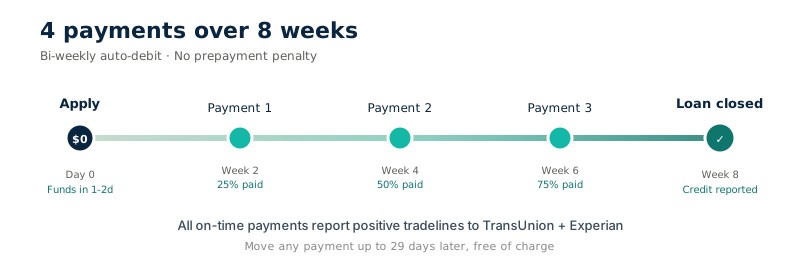
How your loan history affects future loan amounts
Possible Finance's loan amount offers are dynamic. The amount you qualify for on your first loan is rarely the maximum you'll ever be able to borrow — the algorithm rewards consistent on-time repayment with progressively higher offers, and penalizes late payments or skipped applications with reduced maximums or temporary lockouts.
First loan amounts (the underwriting baseline)
For first-time applicants, Possible's algorithm assigns a "trust tier" based primarily on your linked checking account's 90-day history. The factors weighted most heavily, in approximate order of importance:
- Consistent direct deposits. Regular paychecks signal income stability. Two or more deposits per month from the same employer in the last 90 days bumps you toward a higher first-loan offer.
- Average daily balance. Accounts that maintain even a small positive balance ($50+) consistently are scored higher than accounts that frequently swing near zero.
- Overdraft frequency. Zero overdrafts in 90 days = strongest signal. One overdraft = neutral. Three or more = significant reduction in approval likelihood and amount.
- Account age. Newer accounts (less than 6 months) receive smaller initial offers regardless of activity.
- State maximum. Your state's cap is the absolute ceiling no matter how strong other factors are.
Most first-time approved applicants see offers between $100 and $250, not the advertised $500 maximum. This is intentional — Possible builds the relationship gradually before extending larger amounts.
Repeat loan amounts and the loyalty curve
After successfully repaying your first loan, the algorithm reassesses. The pattern most borrowers report:
- 2nd loan offer: Typically $50–$100 higher than the first if repayment was fully on-time and on-schedule
- 3rd loan offer: Another $50–$100 increase, approaching state maximum
- 4th loan and beyond: Maximum state-allowed amount usually unlocked, assuming continued on-time repayment
One important caveat: the loyalty curve only goes UP if you actually take repeat loans. Borrowers who pay off their first loan and don't borrow again for 12+ months effectively restart the underwriting process when they return — the algorithm treats long gaps similarly to first-time applicants.
What reduces your future loan amount
The fastest ways to see your offered amount drop or disappear:
Actions that lower future loan offers
- Late payment: Single late payment by more than 5 days typically reduces next loan offer by 25–50%
- Multiple insufficient-funds (NSF) hits: Each NSF event during a Possible loan period flags your account; 3+ over the loan's lifecycle usually triggers a 60-day cooldown before reapplying
- Closing the linked bank account: Closing or changing your primary Plaid-linked checking account before the loan is repaid will reduce or zero out future offers
- Charge-off: A defaulted Possible loan that gets charged off results in permanent ban from the platform — not just lowered limits
Why Possible doesn't offer bigger loans
It's reasonable to ask why a lender capping at $500–$600 exists in a market where competing personal-loan apps offer $1,000 to $50,000. The answer comes down to regulatory positioning, underwriting model, and target market economics.
Regulatory positioning
State lending laws often treat loans differently based on size. In several states (Texas, California, Oregon, Washington), small-dollar loans under $500 fall under "consumer loan" or "deferred deposit" rules with simplified licensing, while loans over $500 trigger different licensing requirements that include monthly reporting, larger reserve requirements, and stricter APR caps.
Possible Finance operates under licenses that match the small-dollar tier specifically. Expanding to larger loans would require state-by-state re-licensing — an expensive and slow process the company hasn't pursued.
Underwriting model constraints
Possible's no-FICO-check underwriting uses 90 days of banking activity as the primary signal. This data is reliable for predicting whether someone can repay a $200–$500 obligation across 4 paychecks, but loses predictive accuracy at higher amounts. For larger loans, lenders typically need credit bureau data, debt-to-income calculations, and longer income verification — the operational overhead doesn't fit Possible's cost structure.
If you need more than $600: what to consider
If you've already determined Possible's maximum loan amount won't meet your need, the most likely better alternatives by amount:
| You need | Best alternative | Why |
|---|---|---|
| $601–$1,500 | Credit union PAL | Federal credit unions offer Payday Alternative Loans 28% APR cap, up to $1,000-$2,000 |
| $1,500–$5,000 | OppLoans, LendingPoint | Bad-credit installment lenders 59-160% APR, 9-24 month terms |
| $5,000–$50,000 | Upgrade, LendingClub, Best Egg | Personal loans for fair credit (580+ FICO), 7-36% APR |
| Emergency only, <$300 | EarnIn, Brigit, Dave | Cash advance apps with no APR, just optional tips or $1-$15 subscription |
Frequently Asked Questions
What is the maximum Possible loan amount?
The standard maximum is $500. In seven states (Delaware, Florida, Idaho, Ohio, Texas, Utah, and Washington), the maximum is $600. The Possible Advance cash advance product is capped at $300 for subscribers and $100 for non-subscribers.
Why was I approved for less than I requested?
Possible's underwriting system approves the highest amount your banking profile supports, which may be lower than the state maximum. Limited banking history, low average balance, or recent overdrafts can all reduce your approved amount. First-time borrowers typically receive smaller initial loans.
Can I increase my Possible loan amount?
Yes, in many cases. Repaying a loan in full and on time often increases the amount offered on future applications. Continued banking activity that demonstrates stable cash flow also improves limits.
Is there a minimum loan amount?
Possible Finance generally offers loans starting at $50, though the minimum may vary by state. You can request any amount up to your approved maximum.