Possible Finance APR, fees, and the true cost of borrowing.
Possible Finance markets itself as cheaper than a payday loan, and on a per-fee basis it usually is. But the APR-equivalent — 65% to 163% depending on your state — still lands well above what most consumer-finance advocates would recommend. Here's the math, the per-state breakdown, and the comparisons that actually matter.
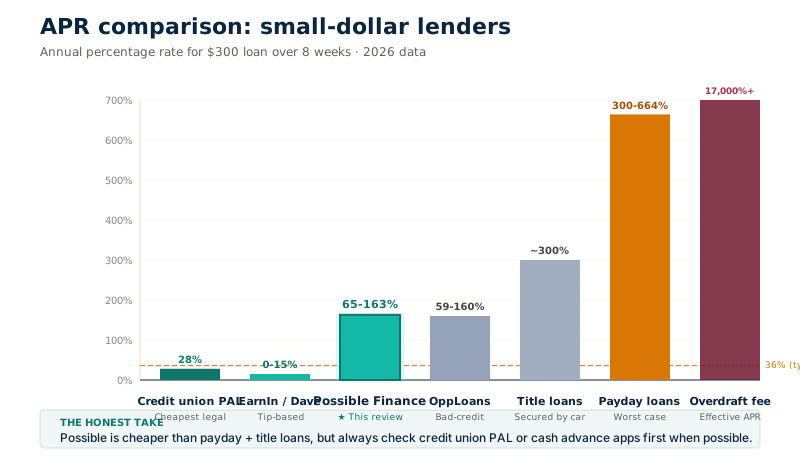
Possible Finance costs $10 to $25 per $100 borrowed, depending on state. On a $300 loan that translates to roughly $30 to $75 in total fees over 8 weeks — an APR of approximately 65% to 163%. There are no late fees, no rollover fees, and no NSF fees from Possible itself. Compared to a storefront payday loan, Possible is structurally safer but not dramatically cheaper. Compared to a credit-union signature loan or a 0% APR cash advance app like EarnIn, Possible is meaningfully more expensive.
How Possible's fee structure actually works
Unlike a traditional installment loan that accrues compounding interest day-by-day, Possible charges a single flat fee per dollar borrowed at the time the loan is originated. That fee is then divided evenly across the four scheduled biweekly payments.
Related: see our guide on what happens with late payments for more detail.
The basic math is:
- Principal: The amount you borrow (typically $50 to $500, up to $600 in 7 states)
- Fee: A state-specific dollar amount per $100 borrowed
- Total repayment: Principal + fee, divided into four equal biweekly payments
For example, on a $300 loan in California:
- Principal: $300
- Fee: approximately $60 ($20 per $100, varies slightly)
- Total to repay: $360
- Each of the four payments: $90
- Effective APR: approximately 130%
The exact fee schedule isn't published as a master table — Possible disclosure shows up in-app once you've been pre-approved and selected a loan amount, because the fee can vary based on state, the specific amount, and your borrower profile. Most published reviews and Trustpilot data confirm the $15 to $25 per $100 range.
Fees and APR by state (representative ranges)
Because Possible operates either directly licensed or through Coastal Community Bank in different states, the fee economics vary. The table below shows the typical fee range and corresponding APR for a representative $300 loan with 8-week repayment.
| State group | Typical fee per $100 | Total fee on $300 | Effective APR (approx) |
|---|---|---|---|
| California, Washington, Hawaii | $15–$18 | $45–$54 | ~98%–117% |
| Idaho, Nevada, Utah, Ohio | $18–$22 | $54–$66 | ~117%–143% |
| Texas (Credit Access Business) | $20–$25 | $60–$75 | ~130%–163% |
| Coastal Community Bank states (27 states) | $15–$25 | $45–$75 | ~98%–163% |
Fees and APRs are representative ranges based on aggregated borrower disclosures from app screenshots, Trustpilot reviews, and Possible's published rate disclosures. Actual rates vary by loan amount, state, and individual borrower profile. The exact rate for your loan is disclosed in the app before you accept.
Cost on $200, $300, and $500 loans
Working through realistic scenarios so you can see the actual dollars:
$200 loan (the typical first-time amount)
- Principal: $200
- Total fee (at ~$20 per $100): approximately $40
- Total to repay: $240
- Each of 4 biweekly payments: $60
- Effective APR: approximately 130%
$300 loan
- Principal: $300
- Total fee (at ~$20 per $100): approximately $60
- Total to repay: $360
- Each of 4 biweekly payments: $90
- Effective APR: approximately 130%
$500 loan (typical maximum in 27 states; up to $600 in 7 states)
- Principal: $500
- Total fee (at ~$20 per $100): approximately $100
- Total to repay: $600
- Each of 4 biweekly payments: $150
- Effective APR: approximately 130%
One thing worth noting: the APR stays roughly the same regardless of loan size, because the fee scales linearly with principal. This is different from compounding-interest loans, where a higher principal increases the absolute interest cost without changing the rate.
The instant-funding fee (separate from the loan fee)
When you're approved, Possible gives you two funding options:
- Standard ACH: Free. Funds arrive in your bank account in 1 to 2 business days.
- Instant funding to debit card: Costs $5 to $15 depending on your debit card's processor. Funds arrive within minutes.
The instant-funding fee is treated separately from the loan fee — it's deducted from the disbursed amount, not added to your repayment schedule. If you borrow $300 and pay $9 for instant funding, you receive $291 immediately and still owe $360 (the $300 principal plus the $60 loan fee).
For a $200 loan, paying $9 to access $191 instantly is an additional ~4.5% transaction cost on top of the ~130% APR. Whether that's worth it depends on whether the cash crisis you're addressing actually costs more than $9 to delay by 24 to 48 hours.
What Possible doesn't charge (and why it matters)
Possible's fee discipline is genuinely better than the typical payday lender:
- No late fees. If you miss a scheduled payment date, you don't get charged extra. Your payment schedule may be restructured, but the total fee is fixed.
- No NSF fees (from Possible). If an ACH debit bounces, Possible doesn't add a returned-payment fee. Your bank may still charge its own NSF fee, but that's on your bank, not on the lender.
- No rollover fees. You cannot "extend" a Possible Loan by paying just the fee. The four-payment structure is fixed.
- No prepayment penalty. Pay off the loan early at no cost. You still owe the fee disclosed at origination — paying early doesn't reduce it, but it doesn't add to it either.
- Free rescheduling. You can move any of the four payment dates up to 29 days from the original due date at no charge, no questions asked, no credit impact.
This combination of "no late fees + free 29-day rescheduling" is what makes Possible structurally different from a payday lender. A traditional payday loan charges an additional ~$15-$30 fee for every two-week rollover, and that's where the borrower spiral usually starts.
How Possible's cost compares to alternatives
On the same $300 borrowing need, here's what the alternatives cost:
| Source | Cost on $300 | Effective APR | Tradeoff |
|---|---|---|---|
| Possible Loan | $45–$75 | 65%–163% | Approves bad credit, reports to bureaus |
| EarnIn cash advance | $0–$13.99 (tip) | 0% | Capped at your earned wages, no credit building |
| Brigit cash advance | $9.99/mo subscription | ~0% (flat fee) | Subscription required, lower instant amounts |
| Dave cash advance | $1/mo + $1.99 instant fee | ~0% (flat fee) | Limited to ~$500 ExtraCash, optional tipping |
| Credit union PAL (Payday Alternative Loan) | $15 application fee + ~28% APR | ~28% | Requires credit-union membership and approval |
| Subprime personal loan (OppLoans, etc.) | ~$30–$60 (12-month term) | 59%–160% | Larger amounts ($1K–$4K), longer terms |
| Storefront payday loan | $45–$90 ($15–$30 per $100) | 391%–520% | One lump-sum payment, rollover trap risk |
| Credit card cash advance | 5% fee + ~25% APR daily compounding | ~25%+ | Requires existing credit card with available limit |
| Pawn shop loan | ~$30–$60 (collateral-secured) | ~120%–240% | Lose your collateral if you can't repay |
The clear cheaper alternatives — EarnIn, Brigit, Dave, credit union PALs — generally have one or more of these constraints: they don't work if you're not actively earning, they require subscriptions, they cap your access at a few hundred dollars, or they require credit-union membership and approval. Possible's role in the market is filling the gap when those constraints don't fit your situation.
When the cost is actually worth it
The Possible fee structure makes sense in a narrow set of situations:
- You need credit reporting. If your credit file is thin or empty, the on-time payments Possible reports to TransUnion and Experian can produce measurable score improvements. None of the cheaper cash-advance apps report to bureaus.
- You're not currently earning a paycheck. Apps like EarnIn require active earned wages to advance you cash. Possible doesn't.
- You don't qualify for cheaper alternatives. If your credit prevents you from getting a credit union PAL and your bank account doesn't support Plaid-based cash advance apps, Possible may be your only above-board option.
- You'd otherwise use a storefront payday lender. The structural improvements — installments instead of balloon payment, no late fees, no rollovers — make Possible a meaningfully safer choice than a typical payday store.
Outside those scenarios, the math usually points to something else. Read our Possible Advance vs Loan comparison for the cheaper $15/month subscription alternative within Possible's own product family.
State-specific regulatory disclosures
Different states require different fee disclosures and impose different caps. Some specifics worth knowing:
- California: Loans up to $500 governed by the California Financing Law (CFL); APR disclosure required at origination.
- Texas: Possible operates as a Credit Access Business (CAB) license #1800061850-160823, partnering with a third-party lender. The total cost includes both the lender's interest and Possible's CAB fee.
- Ohio: Loans capped at $1,000 maximum under the Short-Term Loan Act; Possible's actual maximums are lower.
- Washington (home state): Direct-licensed; the loan agreement itself discloses APR per Washington Department of Financial Institutions standards.
For all states, the federal Truth in Lending Act (TILA) requires Possible to disclose the APR, finance charge, payment schedule, and total of payments before you accept the loan. Read those disclosures carefully — they're the legally-binding terms, not the marketing copy.
Ready to check if you qualify?
Pre-qualification doesn't impact your credit score. We'll match you with lenders that fit your situation — results in 60 seconds.
See if you qualifyBy submitting, you agree to be contacted by lenders in APIdiamond’s partner network. Submitting will not affect your credit score.
Want the full picture? Read our complete Possible Finance review covering APRs, eligibility, real customer scenarios, and cheaper alternatives — or jump to the eligibility check form.
Frequently Asked Questions
What is the APR on a Possible Loan?
Effective APRs on Possible Loans range from approximately 65% to 163%, depending on your state and the specific fee structure. The exact rate depends on the per-$100 fee charged in your state, which varies because Possible operates under different consumer-finance laws in each market.
How does Possible Finance charge fees — flat fee or interest?
Possible charges a single flat fee per dollar borrowed, not compounding interest. For example, in many states the fee is $15 to $25 per $100 borrowed. That fee is divided across the four scheduled biweekly payments and disclosed upfront before you accept the loan.
Does Possible Finance have late fees or NSF fees?
No. Possible explicitly does not charge late fees, returned-payment fees, or rollover fees. If a scheduled ACH debit fails because of insufficient funds, Possible will not charge you — though your own bank may charge an NSF fee on its side. This is one of the meaningful structural differences from typical payday lending.
How much does a $300 Possible Loan actually cost?
On a $300 Possible Loan in a typical state, total fees are approximately $54 to $75 over the 8-week repayment period. That works out to an APR of roughly 90% to 110%. You repay the $300 principal plus the fee across four biweekly payments of about $88 to $93 each.
Is Possible Finance cheaper than a payday loan?
On a per-fee basis, Possible's costs are similar to or slightly lower than typical storefront payday loans. The structural differences make Possible meaningfully safer — no rollovers, no late fees, four installments instead of one lump-sum balloon, and credit reporting that can help your score over time.
Why are Possible Finance's APRs so high if it doesn't charge interest?
APR (Annual Percentage Rate) is a standardized calculation required by the federal Truth in Lending Act that converts any fee structure into an annualized rate. A flat $20 fee on $100 borrowed for 8 weeks looks small as a fee, but annualized — as if you were rolling the same loan all year — it equates to a high APR. The APR figure exists specifically to let consumers compare different fee structures on an apples-to-apples basis.