Is Possible Finance legit? The full regulatory paper trail.
Short answer: yes. Possible Finance is a real, licensed lender that's been audited and accredited by the same regulators that oversee every other consumer lender in the country. The longer answer — whether it's the right product for your situation — is a separate question, and this guide walks through what each regulator and watchdog actually has on file.
Possible Finance is legitimate. Possible Financial Inc. is a Delaware-incorporated Public Benefit Corporation headquartered in Seattle, founded 2017. It's registered with the NMLS under license #1697898, BBB-accredited since 2018 with an A+ rating, and operating in 34 states either through direct state lending licenses or in partnership with Coastal Community Bank (FDIC-member). It has served over 750,000 customers. There are no active CFPB enforcement actions or major regulatory settlements on file as of June 2026.
What the NMLS registry actually shows
The Nationwide Multistate Licensing System (NMLS) is the consumer-facing portion of the licensing infrastructure used by every state banking regulator in the United States. If a company lends money to consumers, it has to be registered. You can search any lender at the public NMLS Consumer Access portal to verify.
Possible's NMLS record shows the following:
- Legal entity: Possible Financial Inc. (DBAs: Possible Finance, Possible)
- NMLS unique identifier: 1697898
- Headquarters: Seattle, Washington
- Year licensed: 2017
- Direct state lending licenses: Alaska, California (License #10DBO-105848), Hawaii, Idaho (License #RRL-10073), Louisiana, Nevada (License #CDTH11200), Ohio (License #ST.760161.000), Utah, Washington (License #530-CC/SL-111888)
- Texas Credit Access Business license: #1800061850-160823
In the 27 states where Possible doesn't hold a direct license, loans are originated by Coastal Community Bank (NMLS #462721) — a Washington-based community bank that's been FDIC-insured since 1997 — and serviced through the Possible Finance app. This bank-partnership model is common in fintech and is regulated under the same federal banking statutes that govern any FDIC-insured institution.
What "direct-licensed" vs "bank-partner" means for you
Practically, the difference is administrative. In either arrangement you can file a complaint with your state's banking regulator or with the CFPB. The bank-partnership structure simply lets Possible operate in states where its product structure — small principal, biweekly installments, flat fee — wouldn't qualify under standalone consumer-lender statutes. Your consumer protections under the federal Truth in Lending Act (TILA), the Electronic Fund Transfer Act (EFTA), and the Fair Credit Reporting Act (FCRA) apply identically.
The BBB record: A+ since 2018
The Better Business Bureau gives Possible Finance an A+ accreditation rating — the highest tier the BBB issues — and Possible has been accredited since October 10, 2018. Accreditation means the company has agreed to the BBB's standards for advertising transparency, complaint resolution, and customer communication for nearly eight years.
The current BBB profile (filed under "Possible Finance" in Seattle, WA) shows several thousand customer reviews with an average around 4.5 stars, plus several hundred closed complaints. The recurring complaint themes:
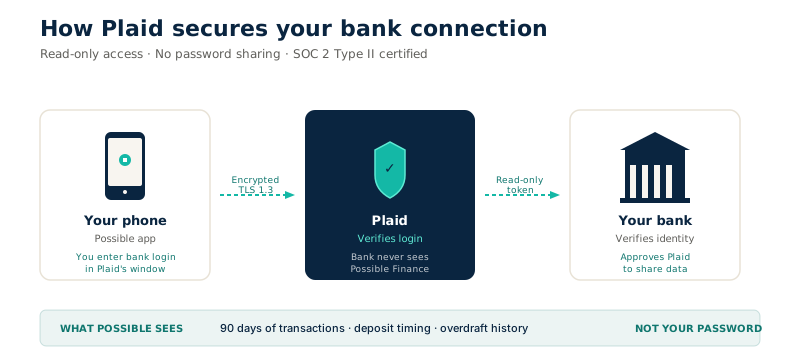
- App or Plaid issues — Plaid not connecting to specific banks (especially smaller credit unions and online-only banks), payment failures despite available funds, identity verification stalls.
- Customer service friction — slow email response times, no phone-based escalation path, and difficulty reaching a human when a specific account issue is stuck.
- Credit-reporting confusion — borrowers seeing temporary credit-score dips when their loan closes, then assuming Possible damaged their credit (in reality, the drop is from FICO's account-age mechanics).
- Disbursement delays — instant-funding to debit card sometimes failing and falling back to 1–2 business-day ACH transfer, often without clear in-app messaging about why.
What you generally do not see in BBB complaints: claims of stolen money, unauthorized withdrawals, fake loans, or identity-theft style fraud. The complaint pattern looks like a real lender with operational growing pains, not a scam.
CFPB complaint database: what's on file
The Consumer Financial Protection Bureau maintains a public complaint database at consumerfinance.gov/complaints where anyone can search for complaints against a specific company. Possible Financial Inc. has dozens of complaints on file, with the breakdown roughly:
- About 50% relate to credit reporting — borrowers disputing how Possible reported a closed account, claiming a paid-off loan still shows a balance, or asking for tradeline corrections.
- About 30% are loan-disbursement and servicing issues — application stuck in review, funding sent to the wrong account, payment posted incorrectly.
- About 15% involve account access — locked out of the app, two-factor authentication failures, lost phone access during identity verification.
- The remaining 5% are miscellaneous (collections, debt-validation requests, etc.).
Importantly, none of those complaints have triggered a CFPB enforcement action. Compare that to companies with serious regulatory issues — like Cash America (CFPB fined $14M in 2013) or Wells Fargo (multiple consent orders) — and Possible's file is unremarkable for a financial services company of its size.
State-level regulator records
Beyond NMLS and CFPB, each state's banking regulator maintains its own complaint and enforcement file. Spot checks of the major direct-licensed states show:
Related: see our guide on reach Possible Finance customer support for more detail.
- California Department of Financial Protection and Innovation: No enforcement actions on file against Possible Financial Inc. as of 2026.
- Washington Department of Financial Institutions: Active consumer-finance license in good standing, no public actions.
- Ohio Division of Financial Institutions: License #ST.760161.000 active and in good standing.
- Texas Office of Consumer Credit Commissioner: Credit Access Business license #1800061850-160823 active.
A lender that's been operating for nine years across more than 30 states with zero state enforcement actions is a strong signal of regulatory legitimacy.
Trustpilot and third-party review aggregators
Trustpilot ranks Possible Finance around 4.4 to 4.6 out of 5 based on thousands of verified reviews. The positive themes that come up consistently:
- Funding speed when everything goes smoothly (often within minutes to a debit card)
- The flexibility of rescheduling any of the four payments up to 29 days at no cost
- Genuine credit-score increases reported by borrowers with thin or limited credit history
- The lack of payday-style fee traps — no late fees, no rollover, no surprise charges
The negative themes are nearly identical to the BBB pattern: app frustrations, Plaid integration problems, customer-service slowness, and occasional state-eligibility surprises. On PissedConsumer the tone is harsher (which is the platform's nature), but the complaints themselves track to the same operational categories rather than fraud.
What would actually be red flags (and why none apply here)
If you're trying to identify whether a small-dollar lender is legitimate, the regulators' shortlist of red flags is well-documented. Here's how Possible measures against each:
| Red flag | Possible Finance status |
|---|---|
| No NMLS registration | Registered (#1697898) since 2017 |
| No state licensing or bank partner | Direct-licensed in 9 states, bank partnership (Coastal) in 27 more |
| Demands upfront fees before disbursing funds | Never. Fees are only deducted with each scheduled payment. |
| Asks for unusual personal information (gift cards, wire transfers, crypto) | Never. Only standard KYC info via Plaid + government ID. |
| Cannot be found in BBB or CFPB databases | Present in both, with established records. |
| Pressures applicants to act fast | No high-pressure tactics; you can decline an offer in-app. |
| Charges late fees, rollover fees, or NSF fees | None of these. Late payments don't trigger fees, just an updated payment schedule. |
When "legitimate" isn't enough
Being legitimate doesn't make Possible Finance the right choice for everyone. The product is expensive — APRs typically range from 65% to 163% — which is far above the rates of most credit unions, secured credit cards, or even some other cash-advance apps like EarnIn and Brigit. If you have time and meet basic eligibility, cheaper options usually exist. We cover the affordability tradeoffs in our APR and fees breakdown and our borrowing limit guide.
But "legitimate but expensive" is meaningfully different from "scam." If you're weighing Possible against a storefront payday lender or a high-APR pawn loan, the licensing comparison, the no-late-fee policy, and the credit-reporting upside all matter.
How to verify any lender yourself (60-second checklist)
- Go to nmlsconsumeraccess.org and search the lender's name. Confirm the NMLS ID matches what's on their site or in their app.
- Visit bbb.org and search the company. Check accreditation status, rating, and the breakdown of complaints over the last three years.
- Go to consumerfinance.gov/complaints and search the company. Look for any pattern suggesting systemic issues.
- Search your state's banking regulator (e.g., dfpi.ca.gov for California) for the company name. Check for active license and any enforcement orders.
- Read recent Trustpilot and Reddit threads with the lender's name plus a current year. Pay attention to pattern, not isolated complaints.
Apply that checklist to Possible Finance and every item checks out clean. Apply it to a random "guaranteed approval" lender that emailed you out of nowhere, and you'll typically find no NMLS record, no BBB presence, and a domain registered three months ago. That's the difference between legitimate and predatory.
Ready to check if you qualify?
Pre-qualification doesn't impact your credit score. We'll match you with lenders that fit your situation — results in 60 seconds.
See if you qualifyBy submitting, you agree to be contacted by lenders in APIdiamond’s partner network. Submitting will not affect your credit score.
Want the full picture? Read our complete Possible Finance review covering APRs, eligibility, real customer scenarios, and cheaper alternatives — or jump to the eligibility check form.
Frequently Asked Questions
Is Possible Finance a real licensed lender?
Yes. Possible Financial Inc. is registered with the NMLS Consumer Access registry under unique identifier #1697898. It holds direct state lending licenses in Alaska, California, Hawaii, Idaho, Nevada, Ohio, Utah, and Washington, and partners with Coastal Community Bank (FDIC-member, NMLS #462721) to issue loans in 27 additional states.
Is Possible Finance accredited by the Better Business Bureau?
Yes. Possible Finance has been BBB-accredited since October 10, 2018, and currently holds an A+ rating — the BBB's highest tier. The BBB profile shows several thousand customer reviews with an average around 4.5 out of 5 stars, alongside a few hundred closed complaints typically about app glitches and verification delays.
Does the CFPB have any enforcement actions against Possible Finance?
As of June 2026, the Consumer Financial Protection Bureau has not filed any enforcement actions, consent orders, or civil penalties against Possible Financial Inc. The CFPB's public complaint database does include individual complaints from borrowers — mostly about credit-reporting disputes and disbursement delays — but none have escalated to formal enforcement.
Why do some online reviews call Possible Finance a scam?
Most 'scam' complaints relate to three things: temporary credit-score drops when a loan closes (caused by normal account-age aging, not fraud), Plaid linking failures that delay funding, or difficulty reaching live phone support since Possible operates email- and in-app-only. These are legitimate frustrations, but they aren't fraud.
Is Possible Finance the same as Possible Mortgage or Possible Funding?
No. 'Possible Finance' and the standalone 'Possible' brand refer specifically to Possible Financial Inc., a Seattle-based fintech founded in 2017. There are unrelated companies that use similar names in mortgage and commercial financing. Before applying, confirm the lender's NMLS ID matches #1697898.
Has Possible Finance ever been sued by customers or regulators?
Public court records show typical small-claims and arbitration disputes between Possible and individual customers — nothing unusual for a lender with over 750,000 customers. There is no class action settlement, no state attorney general settlement, and no CFPB consent order on file as of June 2026.